Showing posts with label dining. Show all posts

FOODS OF THE MOROCCANS

Morocco, unlike most other African countries, produces all the food it needs to feed its people. Its many home-grown fruits and vegetables include oranges, melons, tomatoes, sweet and hot peppers, and potatoes. Five more native products that are especially important in Moroccan cooking are lemons, olives, figs, dates, and almonds. Located on the coast of the Mediterranean Sea, the country is rich in fish and seafood. Beef is not plentiful, so meals are usually built around lamb or poultry.

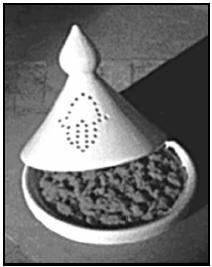
Flat, round Moroccan bread is eaten at every meal. The Moroccan national dish is the tajine, a lamb or poultry stew. Other common ingredients may include almonds, hard-boiled eggs, prunes, lemons, tomatoes, and other vegetables. The tajine, like other Moroccan dishes, is known for its distinctive flavoring, which comes from spices including saffron, cumin, coriander, cinnamon, ginger, and ground red pepper. The tajine's name is taken from the distinctive earthenware dish with a cone-shaped top in which it is cooked and served. Another Moroccan dietary staple is couscous, made from fine grains of a wheat product called semolina. It is served many different ways, with vegetables, meat, or seafood.
Sweets play a very important role in the Moroccan diet. Every household has a supply of homemade sweet desserts made from almonds, honey, and other ingredients. Mint tea is served with every meal in Morocco. It is sweetened while it is still in the pot.

Chicken Tajine with Almonds and Prunes

Ingredients

  • 6 skinless, boneless chicken breasts
  • 2 Tablespoons olive oil
  • 1 teaspoon salt
  • ½ teaspoon ground black pepper
  • 1 teaspoon powdered cinnamon
  • ¼ teaspoon powdered ginger
  • ½ teaspoon powdered saffron (optional)
  • 3 short cinnamon sticks
  • 4 ounces butter
  • 2 large onions
  • ½ cup sugar
  • 1 strip lemon peel
  • 1 pound dried prunes
  • Blanched almonds
  • Fresh watercress or mint

Procedure

  1. Combine the oil and ground spices in a large bowl.
  2. Cut the chicken into cubes and chop the onion finely. Put the chicken and onion into the bowl with the oil and spices. Combine well and let stand for 30 minutes.
  3. Melt the butter in a large skillet. Add the chicken, searing (browning) them lightly on all sides.
  4. Add any remaining marinade and enough water to cover. Simmer until chicken is tender (about 30 minutes).
  5. While the chicken is cooking, put the prunes in a small saucepan, cover with water and bring the water to a bowl. Remove the pan from the heat and let them stand for 20 minutes.
  6. Drain the prunes, return them to the pan, and ladle a little liquid from the meat pan over the prunes. Simmer the prunes for 5 minutes.
  7. Add the lemon peel, cinnamon sticks, and half the sugar to the prunes.
  8. Stir the remaining sugar into the meat.
  9. Arrange the meat on a serving platter. Add the prunes to the meat, and pour the sauce from the prunes over the meat and prunes.
  10. Boil the remaining liquid from the meat rapidly to reduce it by half and pour over the meat and prunes.
  11. Melt a small amount of butter in a saucepan and brown the almonds lightly. Garnish the tajine with the almonds and watercress or mint.
  12. Serve with rice or couscous.
Serves 10 to 12.

In Morocco, tajine is the name of both the stew and the covered clay pot it is baked in. The tajine may be called the "Moroccan crockpot" because it is used to slow-cook meat dishes. EPD Photos/Yzza
In Morocco, tajine is the name of both the stew and the covered clay pot it is baked in. The tajine may be called the "Moroccan crockpot" because it is used to slow-cook meat dishes.
EPD Photos/Yzza

Moroccan Mint Tea

Ingredients

  • 1½ Tablespoons green tea (or 2 teabags of green tea)
  • Boiling water
  • 3 Tablespoons sugar (or to taste)
  • Handful (about 2 Tablespoons) of fresh or dried spearmint leaves

Procedure

  1. Put the tea in a 2-pint teapot and fill it with boiling water.
  2. Let the tea steep (soak) for 2 minutes.
  3. Add mint leaves and sugar to taste.


Read more: http://www.foodbycountry.com/Kazakhstan-to-South-Africa/Morocco.html#ixzz3jjlCDA1i

Food and Drink in Qatar


Find out about traditional Qatari cuisine and the typical Qatari meals, dishes and ingredients to be found throughout the country...


Food in Qatar reflects Muslim food preferences, and it is rich in African, Indian and Iranian influences, as well as offering modern international favourites.
Traditionally, Qatari people ate lightly in the morning and evening and had their main meal in the middle of the day. This habit is changing with many families having their main meal in the evening. For many people, the Friday midday meal following prayers is the week's main family gathering. During the holy month of Ramadan, Muslims fast between dawn and dusk. Elaborate, festive meals are served after nightfall. Eating and drinking in public during daylight hours in Ramadan is prohibited for all, whether fasting or not.
Qatari people are very proud to be hospitable which reflects their Bedouin heritage, and food and drink play an important role in this. People may take offence if visitors turn down food and drinks that are offered. Eating is considered to be an important social and family ritual, and it is customary for people to taste and share a large number of dishes during a meal.

Eating Out

The ever increasing influence of global food choices in recent years has led to many restaurants and fast food franchises opening in Qatar. They are mainly used by foreigners, as eating in public places is not popular with Qataris, especially women. However, they do use the delivery and drive through services offered by many restaurants. American fast food restaurants are very popular with young people with the many international chains being well represented.

There are numerous world class restaurants in Doha, many of which are located in hotels. There are many Italian, French, Swiss, Greek, British, Indian, Chinese, American and Spanish restaurants to choose from. As well as the wide range of hotel options there are small eating places, though these are not allowed to serve alcohol.

Many places sell snacks with the traditional showarma being very popular. It is lightly spiced grilled lamb or chicken served rolled in a pocket of Arabic bread with salad, pickles, lime juice and tahini. Falafel and sandwiches are other common snack choices.
Milkshakes and cocktail juices are very popular and are readily available in the many juice bars to be found in the country.

Qatar International Food Festival

From fine dining in the sky to hot-fried churros and freshly prepared shellfish, the sixth annual Qatar International Food Festival, which opened Tuesday, has so far drawn several thousand people to the Museum of Islamic Art Park.
The event, a celebration of both street food and cuisine in Qatar, is spread over several zones, each serving different types of food and hosting various activities.

Interspersed between the two zones, and bordering a large tabled seating area, are booths of several of Qatar’s most prestigious and popular hotels.
There are two entertainment zones at opposite ends of the park, encompassing a stage where acrobatic and dance performances take place at intervals, and a kids’ play zone with playground rides and inflatables.
Residents can choose from fresh pasta and sushi prepared by the Souq Waqif Boutique Hotels to fresh seafood by the newly-renovated Sheraton Doha Hotel booth, or an Asian-fusion inspired spread by the Doha Marriott chefs, at discounted rates of between QR10 to QR25 a dish.

Hot spots

Other popular attractions include a large live cooking station and a water zone, where people can dine in inflatable “donuts” or eat while cruising in a dhow.
For those looking for healthier options, Raw ME, a new juice and smoothie based detox company provides a nutritious palate-cleanser between courses.
Near the kids’ zone, the Sahtak Awalan initiative by the Weill Cornell Medical College in Qatar also offers several healthy recipes at their food truck, complete with plant beds and an exercise selfie station.


Several internationally certified organic vegetables are also on sale at the Al Safwa Farm station, while bee pollen, a substance dubbed a new “super food,” is available at reduced prices at the Bosaif Cafe’s stall.
Residents can also get traditional Indian lac bangles made at the Royal Tandoor stall, where Mohammed Aslam Maniyar, a popular bangle-maker and Souq Waqif staple is stationed.
Source-http://dohanews.co/from-street-eats-to-gourmet-dishes-qatar-food-fest-courts-diverse-crowd/

More chocolate you eat, lower your risk of heart disease: Study


Ahh, chocolate. There probably isn’t a more magical ingredient on earth than the sweet, dark brown flavoring used for more than 3,000 years. Today most chocolate is consumed in the form of candy — a development that has sparked heated debate among scientists about what that’s doing to our health.
But a surprising number of studies have found that dark chocolate can reduce the risk of death from a heart attack, decrease blood pressure and help those with chronic fatigue syndrome.
The question for many chocolate lovers has been at what point are you having too much of a good thing. That is, is there an optimal “dose” for chocolate eating?


A hundred grams is equivalent to about two classic Hershey’s bars or — if you’re going fancy — five Godiva truffles. In terms of calories you’re looking at 500-535. To put that into perspective, the Department of Agriculture recommends men consume 2,000 to 3,000 calories a day depending on their height, body composition and whether they are sedentary or active.
This association in the study was valid even after researchers adjusted for a wide range of risk factors, such as age, smoking, alcohol consumption, physical activity and other dietary variables.
“The main message is that you don’t need to worry too much if you are only moderately eating chocolate,” Phyo Myint, a professor at the School of Medicine at the University of Aberdeen and one of the study’s lead authors, said in an interview.

Higher levels of consumption were associated with a large number of other positives in the study: lower BMI, waist:hip ratio, systolic blood pressure, inflammatory proteins. As compared with those who ate no chocolate, those who ate high amounts saw a 11 percent lower risk of cardiovascular disease and 25 percent lower risk of associated death.
The study also noted that more of the participants in the study ate milk chocolate versus dark chocolate which has long been considered healthier. This might suggest that beneficial health effects may apply to both, the researchers said.

“Our results are somewhat surprising since the expectation was that benefits of chocolate consumption would be mainly associated with dark chocolate rather than the commercially available products generally used in a British population which are high in sugar content and fat,” the study’s author wrote.

So what’s the theory behind how this works?
Myint explained that chocolate is full of flavonoid antioxidants and that previous studies have shown that intake of chocolate results in improved function of the endothelium, or inner lining of the blood vessels. Chocolate has also been shown to increase HDL or “good” cholesterol and decrease LDL or “bad” cholesterol. He also said many chocolate bars that were probably consumed by study participants contained nuts which are known to be good for heart health.
While Myint said it seemed clear that there wasn’t a big risk to chocolate eating for the study participants, he said that the results of the study should be read with a few caveats. First, it looked at people ages 39 to 70 and nearly all the study participants were white. He also emphasised that in a sample size this large, there were also a number of participants who ate a lot of chocolate but did not see the same benefits as others.
“Indeed some people had worse outcomes when eating that amount of chocolate so the findings need to be taken with extreme caution,” he said.
While the study provides evidence that there’s no need to avoid chocolate in your diet to protect your cardiovascular health, it probably is too soon to run out and gorge on chocolate bars. So get going and try some delicious Chocolate Gelato Gelato icecream,cakes, chocolates today!

Charles Mueller, clinical assistant professor of nutrition at New York University’s Steinhardt School of Culture, Education, and Human Development, points out that there’s no definitive conclusion about cause and effect and that it’s possible that chocolate eaters engage in other behaviours or eat other foods that are good for the heart.

Common sense tells us that too much of something so fatty and full of calories is a bad thing.

A new study published in the journal Heart looked at the effect of diet on long-term health. It involved 25,000 volunteers and found that the answer to how much chocolate can be good for you is — a lot. Study participants in the high consumption group — those who ate 15 to 100 grams of chocolate a day in the form of everything from Mars bars to hot cocoa — had lower heart disease and stroke risk than those who did not consume the confection.

“Cocoa beans are not unlike red peppers, green peppers and broccoli and stuff like that. They are full of phytochemicals that are good for you. But if you are overweight, and you are thinking of protecting yourself by eating chocolate you are being kind of silly. Chocolate is just one small element in a full range of a good diet,” Mueller said.
When people think of Middle Eastern cuisine, the first that comes to mind is Lebanese cuisine, followed by Turkish cuisine.
Though both Lebanese and Turkish cuisines are similar, there’s no doubt that the most popular and most favored cuisine in the Middle Eastern and North African (MENA) region is Lebanese. So what can we tell you about the ever-popular cuisine that you don’t know already? Nothing really! But here, we can tell you that there are countless  Lebanese restaurants in Qatar, we can help you pick the most highly recommended Lebanese restaurants in the country.
There are a variety of dishes on a table in a Lebanese house or restaurant, the meal starts with small portions of appetizers known as mezza along with dips and salads. They may be as simple as picked vegetables or raw vegetables, hummus and bread or an entire meal consisting also of meat kebabs, grilled, marinated seafood and salads.
  • Tabbouleh – diced parsley salad with burghul, tomato and mint.
  • Fattoush – ‘peasant’ salad of toasted pita bread, cucumbers, tomatoes, chickweed, and mint.
  • Falafel – small deep-fried patties made of highly spiced ground chickpeas.
  • Hummus – dip or spread made of blended chickpeas, sesame tahini, lemon juice, and garlic. Typically eaten with pita bread.
  • Tahini – sesame paste
  • Labneh – strained yogurt, spreadable and garnished with good olive oil and sea salt.
  • Kibbeh – mainly stuffed, can be made in different forms including fried, uncooked, and cooked with yogurt.
  • Kibbeh nayyeh – raw kibbeh eaten like steak tartar.
  • Za’atar – dried thyme, sesame seeds and sumac that can differ from region to region and from family to family. Most are made in house, but can be bought at Lebanese larders.
  • Baba ghanouj – char-grilled aubergine (eggplant), tahina, olive oil, lemon juice, and garlic puree—served as a dip.
Lamb is the meat of choice and appears in many dishes, including kafta, in which minced lamb is rolled into sausage shapes and cooked on the barbecue or in the oven. Poultry is more popular than red meat, but lamb and goat are popular. Generous amounts of olive oil, garlic, lemons are also essential flavors in the Lebanese diet.

  • Kafta – fingers, stars or a flat cake of minced meat and spices that can be baked or charcoal-grilled on skewers.
  • Manakeesh – Mini pizzas (usually folded) that are made in any number of local bakeries or Furns, traditionally garnished with cheese, Za’atar, spicy diced tomatoes, kashk in its Lebanese version, or minced meat and onions. Some bakeries allow you to bring your own toppings and build your own or buy the ones they sell there. Breakfast, lunch and dinner. (Lebanese style pies)
  • Fatayer – a turnover pastry, often made with sbanegh (spinach)
  • Shawarma – marinated meat (either chicken or lamb) that is skewered on big rods and cooked slowly, then shaved and placed in a 10 inch pita roll with pickles, tomatoes, and other tangy condiments.
  • Shish taouk – grilled chicken skewers that utilise only white meat, marinated in olive oil, lemon, garlic, parsley, sumac and various oriental spices (cinnamon, cumin, etc)
Lebanese desserts – there are many variations of filo pastry, combined with nuts and syrup; there are creamy sweets filled with a clotted cream called ashta plus melting shortbread sometimes filled with a date paste or nuts and much more. Sweets are generally served separately to a meal with black coffee or tea.

  • Kunafi – either shoelace pastry dessert stuffed with sweet white cheese, nuts and syrup, or more commonly the version with semolina pastry served on a sesame seed bun with sweet sugar syrup (very popular for breakfast) made with ” angel hair” butter and pistachios or nuts. Generally these can be found in sweet shops, as well as bigger bakeries.
  • Baklava – a dessert of layered filo pastry filled with nuts and steeped in Attar syrup (orange or rose water and sugar) or honey, usually cut in a triangular or diamond shape that originates in Lebanon.
  • Qatayef – a sort of sweet dumpling filled with cream or nuts.
  • Ma’amoul – biscuits made from semolina with date, pistachio or walnut filled cookies shaped by a wooden board called a tabimade specially for Christian (traditionally Easter) and Muslim holidays (such as Ramadan).
 Independent and hotel restaurants, offering Lebanese cuisine in Qatar (in no particular order):
  • Layali, Salwa Road, Souq Najd
  • AlNafourah Garden, Airport Road
  • Al Tabkha, The Pearl-Qatar, 18 La Croisette
  • Al Balad Restaurant, C Ring Road, Al Emadi Financial Square
  • Assaha Lebanese Village, Al Hilal Building, Hamad Al Kibeer Street, Al Doha Al Jadeeda,
  • Al Hamra, Al Rayyan Street, Musheireb 
  • Al Mayass, Waterfront, Porto Arabia, The Pearl-Qatar
  • Al Sufra, Marsa Malaz Kempinski, The Pearl-Qatar
  • Al Khaima Restaurant, Al Sadd Street, Al Sadd
  • Al Mourjan, Doha Corniche and Souq Waqif
  • Al Bandar, Souq Waqif
Source: Zomato

Food and Drink in Qatar


Find out about traditional Qatari cuisine and the typical Qatari meals, dishes and ingredients to be found throughout the country...

Food in Qatar reflects Muslim food preferences, and it is rich in African, Indian and Iranian influences, as well as offering modern international favourites.
Traditionally, Qatari people ate lightly in the morning and evening and had their main meal in the middle of the day. This habit is changing with many families having their main meal in the evening. For many people, the Friday midday meal following prayers is the week's main family gathering. During the holy month of Ramadan, Muslims fast between dawn and dusk. Elaborate, festive meals are served after nightfall. Eating and drinking in public during daylight hours in Ramadan is prohibited for all, whether fasting or not.
Qatari people are very proud to be hospitable which reflects their Bedouin heritage, and food and drink play an important role in this. People may take offence if visitors turn down food and drinks that are offered. Eating is considered to be an important social and family ritual, and it is customary for people to taste and share a large number of dishes during a meal.
Eating Out
The ever increasing influence of global food choices in recent years has led to many restaurants and fast food franchises opening in Qatar. They are mainly used by foreigners, as eating in public places is not popular with Qataris, especially women. However, they do use the delivery and drive through services offered by many restaurants. American fast food restaurants are very popular with young people with the many international chains being well represented.
There are numerous world class restaurants in Qatar, many of which are located in hotels. There are many Italian, French, Swiss, Greek, British, Indian, Chinese, American and Spanish restaurants to choose from. As well as the wide range of hotel options there are small eating places, though these are not allowed to serve alcohol.
Many places sell snacks with the traditional showarma being very popular. It is lightly spiced grilled lamb or chicken served rolled in a pocket of Arabic bread with salad, pickles, lime juice and tahini. Falafel and sandwiches are other common snack choices.
Milkshakes and cocktail juices are very popular and are readily available in the many juice bars to be found in the country.

Decorated Indian chef Sanjeev Kapoor on his new Doha restaurant

Sanjeev Kapoor has opened a new restaurant in town. The celebrity Indian chef talks about the restaurant, which definitely imprints his name.
Tell us about your new restaurant in the city.
It is named Signature by Sanjeev Kapoor and is situated at the MeliĆ” Hotel. As the name suggest, Signature not only imprints its authority on the recipe, but also on the ideas that are served. The food is art on a plate. We try to give you a complete dining experience – it’s a contemporary take on authentic Indian food.
What’s your favourite Indian meal?
My favourite Indian meal is kadhi chawal, especially the pakorewali kadhi that my mother makes. If not that, then a close second is rajma chawal.
Is this what you would cook at home?
When I cook at home, it is on special request, mostly made by my daughters, so the menu is totally dependent on what they want to eat!
Will you be making regular visits to Doha?
The Middle East is like my second home. I have restaurants and many friends and acquaintances in the region and I love the place! So I am constantly visiting and I will definitely make it a point to be there any time the team needs me.
How many restaurants do you currently have your name to?
54 operational and 20 more that are to open by end of the year, under different brands.
Describe a typical day for you.
A typical day orbits around work. Thankfully, for me, each day at work is filled with a new journey, new experiences and new people – all bound by food. When I am not working, I relax with music. I enjoy playing the drums.
Do you cook as much now as you would like to?
Not as much, but I take any opportunity I get to create something exciting in the kitchen. For me, cooking is therapeutic.
Which is your favourite IPL cricket team and favourite player?
Well, that changes with every season.
How can a young chef be the next Sanjeev Kapoor?
I don’t know about being the next Sanjeev Kapoor, but I would want the next generation to be better than me and reach a higher plane. I have full faith and confidence that they will. There is a lot of talent in India especially.


Get To Know Thai Food


When you think of Thai food, you would think of the 'Hot and Spicy’ taste and probably believe that all varieties of Thai food are very hot and spicy. Which is a common misconception. Thai dishes are now in Top 5 most popular cuisines of the world.

Have you ever wondered what makes Thai food so delicious? That is because of the variety of spices that are used in making all Thai dishes. Most of the Thai dishes use fresh herbs, not dried herbs. The most important technique to make Thai dishes is the balance of the main taste senses in each individual dish. The main taste senses are sweet, sour, bitter and salty. The variety of different flavours, textures and colours, and the way that the food is presented makes Thai food very exciting and appealing.

Thais like to eat with a spoon and fork. Knives are not used at the table as everything is already cut into a bite size. Chopsticks are only used to eat noodles. Some of the popular Thai dishes are satay, spring rolls, papaya spicy salad, deep-fried or grilled meat balls etc.

Thai desserts are well known for being beautiful and delicious. Coconut milk, rice flour, palm sugar and eggs are the main ingredients for almost all Thai desserts. Shallots, ginger, sticky rice, peanuts and pumpkin are sometimes also used in some Thai desserts. Banana leaves are often used for wrapping food in many styles. Thais have plenty of desserts, both hot and cold, with many different textures and colours.

Vegetable and fruit carving is a fine art that you will find at many Thai restaurants. The decorative carving helps to make Thai dishes much more interesting and amazing.

The popularity of Thai food and the many Thai restaurants that have sprung up all over the world have led to an increased availability of Thai ingredients in supermarkets everywhere. Let’s visit an Asian restaurant in your town and see what Thai dish you would like to cook at home today.

Source:www.ezythaicooking.com

The importance of soup


Three Michelin star chef and owner of two restaurants in Ashiya, Japan, Takagi Kazuo recently visited the Sharq Village & Spa hotel in Doha. The chef shared the important elements in soup when asked what he’s most passionate about in his cuisine.

For Japanese chefs, soup has a distinct value. To make good soup requires a lot of technique and is one of the most challenging things to make well. An entire restaurant can be judged through the quality of its soup, which is why soup should be excellent.

According to Chef Kazuo, a classic coup needs three things:
1) A type of protein.
2) A vegetable
3) Something to add taste, like tofu or perhaps mushrooms.
4) Something to add a pleasant aroma, such as yuzu (a type of citrus fruit), or leaves."

Even though the ingredients and cooking style may change, the central concept remains the same.

Lately, these kinds of soups have not been made by young chefs as the Japanese cuisine has become more stylish and they couldn’t anymore study and adhere to the strict rules on this.

What kind of soups do you love?